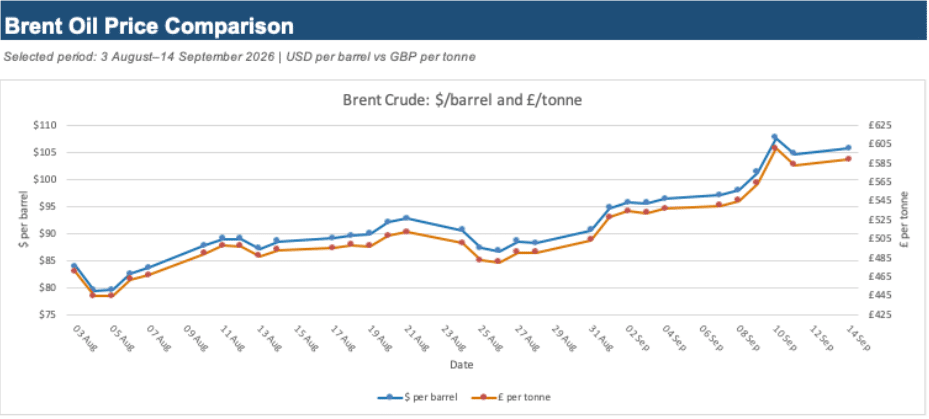
European polymer markets remain calm in the face of rapidly increasing crude oil prices.
The rapidly escalating tensions in the Middle East have driven Brent Crude Oil prices above the critical $100 per barrel threshold in the past few days. Whilst retail domestic petrol and diesel prices have responded by hitting 4-year highs, the polymer markets are pretty subdued even though naphtha prices have also peaked. In £ per tonne terms Brent Crude oil has increased in price by over £100 per tonne since the beginning of September.
Whilst polymer prices in more volatile markets such as Turkey and China are responding with increases, here in the UK and Western Europe the market action is subdued as demand remains relatively weak, and buyers reflect on their hasty actions back in April and May that caused prices to rapidly spike. For now, ample supply is supporting the weak market fundamentals, and it remains to be seen if restrictions in crude oil supply drive more use of naphtha in petrol blends and restricts availability for petrochemical production.
Unless the situation in the Middle East de-escalates before the end of September, polymer feedstock price increases seem inevitable. However, it remains to be seen how the polymer markets will react to this inflationary cost pressure.
Monomer Price Movement
Feedstock
Price per Tonne
Change (contract)
C2 (Ethylene)
£1,262.72
-£10.70
C3 (Propylene)
£1,207.07
-£8.56
SM (Styrene Monomer)
£1,456.19
-£119.85
Benzene
£799.58
-£293.64
Butadiene
£971.65
£42.80
Brent Crude (monthly average)
£485.17
£13.97
Exchange Rates
€
1.17
$
1.35
€/$
1.16
Mike Boswell Executive Chairman – Plastribution Group
In September, the polyolefins market is around rollover to small increase depending on the grade. Although both Ethylene and Propylene contract prices reduced slightly, we have seen crude oil and naphtha rise quite sharply in early September offsetting requests for reductions. Producers also point out that monomers rose quite sharply in August, and the market broadly rolled over so they are looking to recover some of the lost margin.
Geopolitical risk could become a more significant factor, both in terms of feedstock costs and increased shipping rates for material from the Far East. More shipping is avoiding the Red Sea extending lead times and adding costs.
The short-term outlook is relatively balanced. Energy and freight volatility could quickly create upward pressure, but current demand levels suggest that any increases are likely to be selective and difficult to sustain unless availability tightens further. Small increases through the final quarter of the year seem the most likely scenario.
LDPE is sustaining increases and many suppliers are now on order stop. A major European Producer is still in Force Majeure and availability is limited. Price increases of £30-40 / MT are widely reported.
LLDPE
Supply
Demand
LLDPE pricing is broadly a rollover but is under some slight upward pressure as export prices from USA are increasing and there is some concern regarding the impact on exports from the Middle East with the conflict escalating once again.
HDPE
Supply
Demand
HDPE pricing is also broadly flat in September though some upward pressure is appearing as we move later through the month.
PP
Supply
Demand
PP pricing is a rollover in September but as with PE, some concerns are appearing with the escalating conflict in the Middle East and the impact this may have on Supply Chains. Several Far East producers are increasing prices to reflect higher shipping costs.
PS
Supply
Demand
PS pricing is more volatile in September, with styrene moving lower in Europe after the sharp increases seen in August. European PS demand remains weak, particularly in construction-related applications, meaning sellers are unlikely to retain previous gains in full. Any movement is expected to vary by grade, supplier and stock position.
Other Polyolefins
EVA is broadly stable to slightly softer, with improving availability offsetting feedstock-related cost pressure. POP and POE remain more resilient than commodity polyolefins, as speciality grades continue to track monomer and supply dynamics more closely.
The market is predominantly quiet during the summer holiday period with little movement on prices. It is anticipated that things will remain like this until at least September, and there is ample material to satisfy the subdued demand.
The Benzene contract price for August settled at €1,277/t, up by €184/t from July. Availability was reduced as European producers cut outputs and imports from China imports slowed. Demand was also lower so a fairly balanced situation overall.
Pete Tillin Product Manager – Performance Polymers
Performance Polymer Feedstocks £/Metric Tonne by month
No Data Found
ABS
Supply
Demand
Due to cost reductions for styrene monomer, low demand and abundant supply, ABS prices are under downward price pressure. For reference, the styrene monomer contract price decreased by €140/t for September.
PA6
Supply
Demand
Higher stock levels and good availability, along with low demand means that prices will more than likely remain around current levels, despite calls for cost increases.
PA66
Supply
Demand
The situation for PA66 is broadly the same as PA6, so despite rumours of price increases the market remains very subdued so there could even be some reductions.
POM
Supply
Demand
As with many other performance polymers, demand is low and there are no real drivers for any major changes in market prices. The longer-term view is that prices may reduce into the last quarter of the year.
PC
Supply
Demand
The market for PC remains quiet and abundant supply means that prices may reduce over the next few months, despite upward price pressure on some key raw materials.
PMMA
Supply
Demand
Due to the low demand and high stock levels/good availability it is expected that prices may fall.
PBT
Supply
Demand
A similar situation to most other engineering materials.
Other Engineering Polymers
The situation for most other engineering materials is similar, with market prices under some downward pressure and demand generally low.
Recycled Polyolefins have largely rolled over in September, with only limited movement on higher quality grades. Demand has improved more moderately than expected following the implementation of PPWR, while the broader European recycling sector remains under pressure from weak underlying consumption, imported material and challenging operating costs.
Recycled LDPE / LLDPE has remained broadly stable in September, with high quality natural and translucent grades holding firm where recycled content is specified. Black and grey grades remain closer to rollover, with demand still modest in industrial and non-packaging applications. Availability of consistently high quality recycled material remains relatively tight, but competitive virgin pricing and cautious converter buying continue to limit upward price momentum.
Recycled HDPE
Supply
Demand
Recycled HDPE has generally rolled over in September, with natural grades remaining the most supported due to ongoing demand from packaging, consumer goods and applications with sustainability requirements. Industrial grades are still more readily available, although supply and demand appear more balanced than earlier in the summer. Buyers remain cautious, and price increases remain difficult to achieve unless material quality, colour and certification requirements are clearly met.
Recycled PP
Supply
Demand
Recycled PP has remained close to rollover in September. Natural and light coloured grades continue to attract the strongest interest where higher quality recycled content is required, while darker industrial grades remain more readily available. Market sentiment is cautious, with PPWR providing a supportive longer-term demand signal, but short-term buying activity is still limited by weak end-user demand and competition from competitively priced virgin polymer.
Contact Mike Boswell
Executive Chairman
Contact Ian Chisnall
Product Manager – Sustainable Polymers
Contact Pete Tillin
Product Manager – Performance Polymers
The latest updates sent straight to your inbox
Simply enter your details below to subscribe to Price Know-How