Upstream cost inflation drives October polymer prices higher.
Following the outcome of the US mid-term elections, the crude oil market has taken the view that a resolution to the US/Iran conflict is now much more likely, or at least that the movement of crude oil tankers through the Strait of Hormuz will be less constrained.
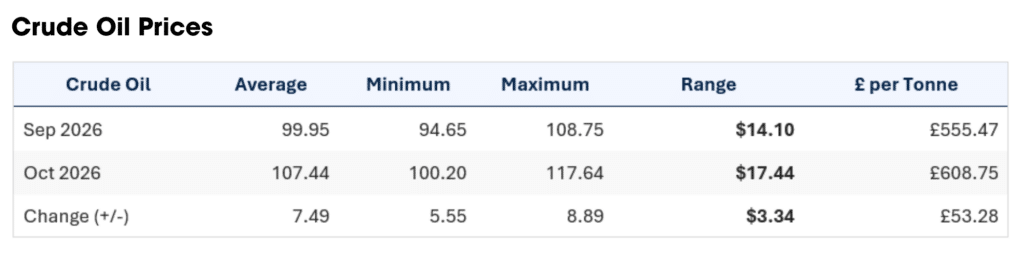
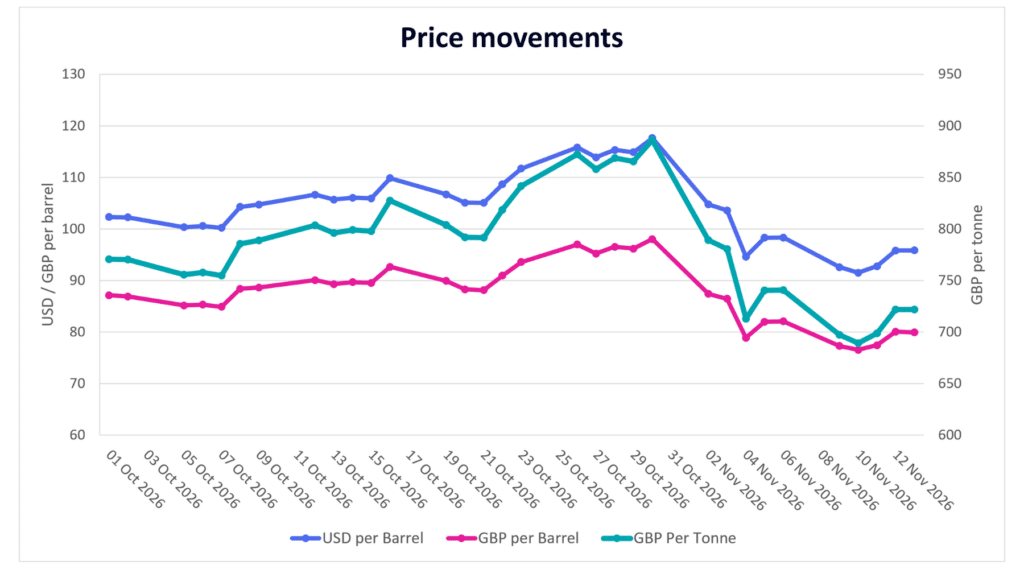
As a result, crude oil prices have fallen significantly, by about 20%. Polyolefin prices have only started to respond to feedstock cost inflation in the last couple of months, so the deflation in crude oil prices is now giving polymer buyers cause for hesitation. Whereas plentiful polymer supply over the summer prevented feedstock cost increases from being passed through, an evaluation of the global supply situation, particularly for PE and PP, suggests that the market has since become significantly tighter. This tightening is partly driven by demand in Asia, where China in particular has moved from being an exporter of many materials to a neutral or importing position.
The effect appears significant enough that the typical US year-end promotions are unlikely to take place this December. Provided that crude oil prices continue to moderate, many plastics converters will be hoping that demand improves as consumer confidence returns and less disposable income is consumed by energy costs and energy-driven inflation. However, progress towards a lasting settlement in the Middle East is likely to face challenges along the way, so further crude oil price volatility should be expected.
Monomer Price Movement
Feedstock
Price per Tonne
Change (contract)
C2 (Ethylene)
£1,377.75
£67.41
C3 (Propylene)
£1,322.98
£67.41
SM (Styrene Monomer)
£1,688.70
£20.22
Benzene
£1,064.28
£57.30
Butadiene
£1,061.76
£63.20
Brent Crude (monthly average)
£608.75
£54.02
Exchange Rates
€
1.19
$
1.33
€/$
1.12
Mike Boswell Executive Chairman – Plastribution Group
In November, European polyolefin producers are seeking price increases following the ethylene and propylene monomer contract settlements, both up by €80 / MT. The settlements reflect the strength of naphtha and wider feedstock costs through October. The size of the increase varies by grade and supplier but most are insisting on at least the €80 / MT monomer movement.
Oil prices have eased since the start of the month, with Brent falling from $113 per barrel at the very end of October to the low-to-mid $90s in the middle of November. The decline has been volatile, however, and renewed security concerns around the Gulf and Strait of Hormuz have brought sharp rebounds. Buyers will argue that lower crude should soften the cost case for further increases, but imports into Europe remain limited, reducing buyer’s options. Disrupted Middle East shipping, high freight and insurance costs and exchange-rate movements are keeping offers limited and delivered prices firm.
The short-term outlook is mixed. The €80 / MT monomer increase, and the lack of imports support producer attempts to increase prices, while falling oil prices and cautious converters limit how far those increases can go. Demand is not strong enough across most grades to support increases much beyond monomer.
LDPE remains the firmest polyethylene grade in November. Restricted European availability, order controls and ongoing production issues, combined with very little import material, are supporting further increases above the €80 / MT ethylene settlement as suppliers recover margin. Buyers should expect increases to be more successful here than in other commodity PE grades, although the outcome will still depend on grade and supplier position, and the recent fall in oil prices gives buyers some basis to push back.
LLDPE
Supply
Demand
LLDPE suppliers are seeking at least the €80 / MT ethylene increase in November. Import offers from the US and Middle East are limited, and freight, exchange-rate and supply-chain risks are keeping delivered costs firm, which reduces the competition that would normally cap local prices. Demand remains cautious, and with oil easing, attempts at increases above monomer are expected to meet resistance.
HDPE
Supply
Demand
HDPE prices are under upward pressure in November as producers seek to pass through the €80 / MT ethylene settlement. Supply is generally adequate from regional producers and demand remains muted, but the lack of imports limits the buyers’ alternatives. Lower oil prices are giving converters grounds to resist anything above monomer. Blow moulding, film and injection grades are settling differently according to local availability and stock position, with blow moulding grades appearing to be the most in demand.
PP
Supply
Demand
PP producers are seeking increases for November in line with the €80 / MT rise in the propylene contract. Attempts to achieve more than the monomer were abandoned in October and are unlikely to return while downstream demand stays weak. Imports into Europe are limited, which helps producers hold the monomer movement, but easing oil prices and ample regional availability still leave buyers in a relatively strong position. The market is expected to firm selectively, with outcomes varying by grade, supplier and customer commitment.
PS
Supply
Demand
PS pricing remains cost-led in November, with styrene, benzene and wider feedstock costs the main reference points for GPPS and HIPS. Producers are seeking to recover higher costs, but weak underlying demand and softer crude prices may restrict margin expansion, and buyers will look to the recent fall in oil to moderate increases. Limited import availability gives some support to regional suppliers. Total Force Majeure has also reduced immediate availability.
Other Polyolefins
EVA is firmer in November as the €80 / MT rise in ethylene supports producer increases, although improved availability and cautious demand may limit the scale of movement. POP and POE remain comparatively resilient, with speciality grades tracking monomer costs, import replacement values and individual supply positions more closely than commodity polyolefins. Limited import availability is adding support to these grades.
The market is still very subdued, and material supply is plentiful. This situation is making producer’s calls for price increases particularly difficult to implement. Rollover or similar is the most probable scenario for most performance polymers for November, and also for the rest of the year.
The Benzene contract price for November settled at €1263/t, up by €68/t from October. Whether this filters down to polymer pricing is unlikely, mainly due to the low levels of demand and abundant supply.
Of more note is the rapidly increasing freight costs, particularly from the Far East which may have to be passed on sooner rather than later.
Pete Tillin Product Manager – Performance Polymers
Performance Polymer Feedstocks £/Metric Tonne by month
No Data Found
ABS
Supply
Demand
Due to low demand and abundant supply, ABS prices are still under some downward price pressure, however the composite raw material costs have gone up yet again, so ABS prices are also under a lot of upwards pressure. Who knows which way they will ultimately go?
For reference, the styrene monomer contract price increased by €24/t for November, it now stands at €2004/t. In addition, butadiene went up by €75/t and ACN by €94/t.
PA6
Supply
Demand
There have been some price increases implemented already, as producers look to recover higher costs. However, the market remains subdued, so this may have little impact on the actual prices due to high stock levels and poor demand.
PA66
Supply
Demand
The situation for PA66 is broadly the same as PA6, with producers trying to implement cost rises. However, low demand and high inventories will probably limit their success.
POM
Supply
Demand
As with many other performance polymers, demand is still subdued and there are no real drivers for any major changes in market prices. The longer-term view is that prices may well stay around current levels.
PC
Supply
Demand
The market for PC remains quiet and abundant supply means that prices may rollover, despite upward price pressure on some key raw materials.
PMMA
Supply
Demand
Due to the low demand and high stock levels/good availability, prices will likely rollover, despite producers’ desires for increases.
PBT
Supply
Demand
A comparable situation to most other engineering materials. Prices will probably rollover or similar.
Other Engineering Polymers
The situation for most other engineering materials is similar, with market prices under pressure, demand low but availability high.
Recycled polyolefin prices have edged higher in November to date, with modest increases most visible for higher-quality natural and translucent grades. Firmer virgin polymer costs have improved the backdrop for recyclates and supported seller sentiment, but weak underlying demand, competitive imports and cautious converter purchasing continue to limit the pace of pass-through. The broader European recycling sector therefore remains under significant margin and operating-cost pressure.
Recycled LDPE / LLDPE prices have moved slightly higher in November. Higher-quality natural and translucent grades have achieved the clearest gains where recycled content is specified, while black and grey grades have seen smaller increases amid greater competitive pressure. Firmer virgin polyethylene costs have supported recyclers’ offers, but adequate availability, imports and cautious buying continue to restrict larger upward movement.
Recycled HDPE
Supply
Demand
Recycled HDPE prices have also firmed modestly in November to date. Natural grades continue to receive the strongest support from packaging, consumer goods and sustainability-led applications and have seen the most noticeable increases, while mixed-colour and industrial grades remain more readily available. Higher virgin HDPE replacement values have strengthened seller sentiment, although subdued demand means increases are still difficult to secure unless material quality, colour and certification requirements are clearly met.
Recycled PP
Supply
Demand
Recycled PP prices have edged up modestly in November to date. Natural and light-coloured grades continue to attract the strongest interest and have achieved the firmest increases where higher-quality recycled content is required, while darker industrial grades remain well supplied. Firmer virgin PP costs offer support, but weak end-user demand and continued competition from lower-priced virgin and imported material are preventing recyclers from achieving broad-based gains.
The latest updates sent straight to your inbox
Simply enter your details below to subscribe to Price Know-How